
· by Michael Blair, Nashville's Deck
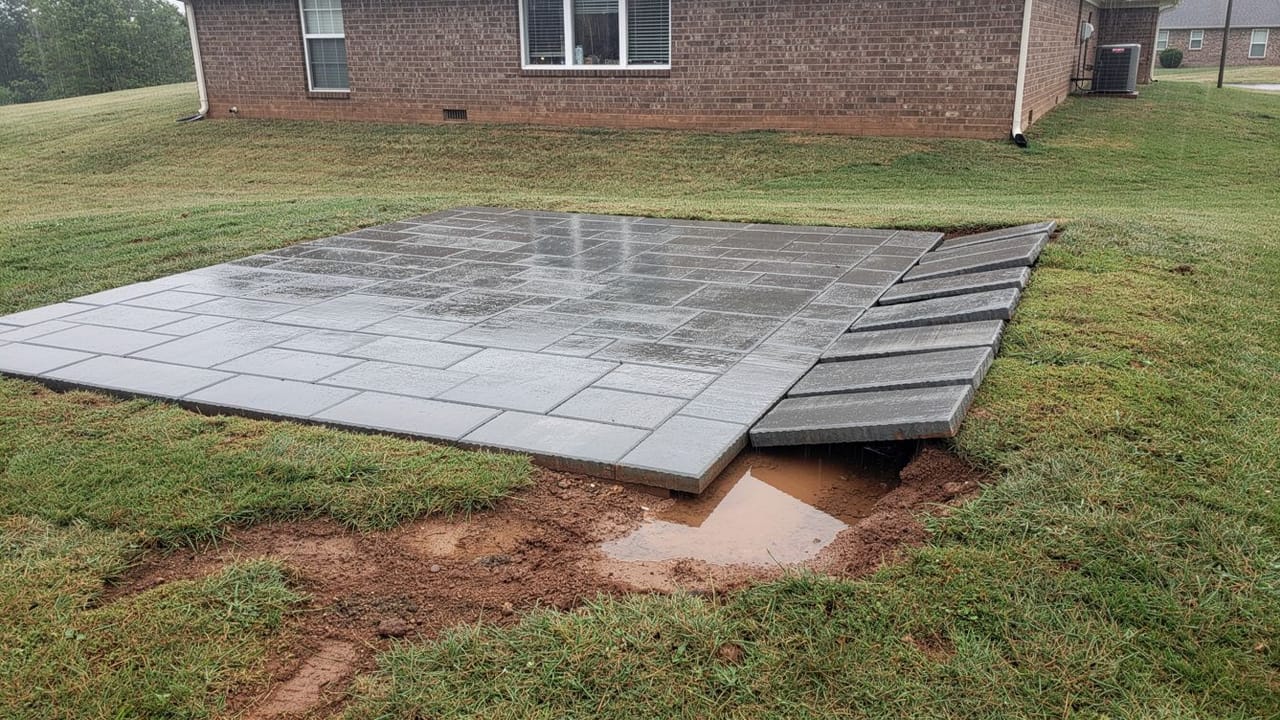
A paver patio fails slowly. First a puddle sits in one spot after rain, then a few pavers along the lawn edge start to rock, and a year later there is a dip you can see from the kitchen window. Owners tend to blame the pavers, but concrete pavers are about the hardest thing in the yard. What moves is the ground and the gravel beneath them, and around Nashville that ground is usually clay. This is what goes wrong under a sinking patio, what the soil here does to it, and how we build the layers so a patio stays flat.
Why do paver patios sink?
Paver patios sink because something under the pavers settles, washes out or squeezes sideways, and the pavers follow it down. The pavers themselves are only the top layer of a stack: native soil at the bottom, called the subgrade, then a compacted gravel base, then a thin bed of sand the pavers sit in, all held in at the sides by an edge restraint. A dip in the surface tells you one of those layers gave way.
The usual causes are a subgrade that was soft or wet when the patio went down, a base that was spread but never properly compacted, fine soil working its way up into the gravel until the base loses its strength, a bed of sand laid too thick so it shifts under weight, and edges with nothing solid against them, so the outer row slowly creeps out into the lawn and the rest follows.
- One low spot that holds water: a soft patch in the subgrade or base under it
- The outer row tilting and spreading: no edge restraint, or one that has failed
- Ruts or waves across the surface: bedding sand too deep, or a base that was never compacted
- A general slow sag after wet seasons: soil mixing into the base from below
What the soil under a Nashville yard does to a patio
The subsoil across much of the Nashville Basin is clay formed from weathered limestone, and that is the ground most patios here are laid on. The USDA NRCS official description of the Talbott soil series describes soils formed in clayey residuum from limestone, with moderately slow permeability and a subsoil of firm, plastic clay, with bedrock at 20 to 40 inches. The USDA NRCS description of the Maury series, Tennessee’s state soil, describes silty material over residuum from phosphatic limestone, with a very firm subsoil ranging from silty clay loam to clay and bedrock much deeper, at 60 to 200 inches or more.
Two things follow for a patio. Clay drains slowly, so water that gets down through the joints or runs off a roof can sit at the bottom of the base for days, and a wet clay subgrade is weaker than a dry one. And where the rock is shallow, digging out for a base can hit limestone well before a crew expects it, which changes how a site is graded and drained. Every yard is different, which is why we dig a test spot and look at what comes out before we price the base. If you are still weighing a patio against a deck for a yard like this, we compared the two in our post on choosing a deck or a patio.
What base keeps a paver patio flat?
A base that is compacted in layers, separated from the clay where the clay stays wet, and held in at the edges keeps a paver patio flat. The construction steps we follow come from Pav-Tec 002 from the Concrete and Masonry Hardscapes Association, an industry association guide to building interlocking concrete pavements derived from ICPI Tech Spec 2. It calls for the subgrade, and the base under pedestrian areas and residential driveways, to be compacted to at least 98 percent of standard Proctor density as specified in ASTM D698. That number is the difference between gravel that was run over once with a plate and gravel that will not settle further under use.
The same guide says geotextile may be used where the soil stays saturated part of the year, as a separation layer that keeps soil from migrating into the aggregate base under loads. On clay that holds water, that fabric is what stops the slow sag from below. It notes that continually wet or weak soils need thicker bases, and that a residential driveway on well-drained soil needs a base of at least 6 inches. A patio carries people rather than cars, and how deep we go on one depends on what the soil and the drainage look like once we have dug.
On top of the base, the guide calls for bedding sand spread and screeded to an uncompacted nominal 1 inch, not a deep layer used to make up for an uneven base. At the edges it calls for a restraint with at least 1 inch of vertical surface in contact with the side of the paver, so the outer row has something solid to push against. New patios we build, open or under a roof, go down in this order; that work is on our covered patio page.
- Subgrade: graded to drain and compacted to at least 98 percent of standard Proctor
- Geotextile: laid over clay that stays wet, to keep the soil out of the gravel
- Aggregate base: compacted in lifts to the same standard, deeper on wet or weak ground
- Bedding sand: screeded to about 1 inch, uncompacted, before the pavers go down
- Edge restraint: a solid edge against the side of the outer pavers, all the way around
How do you fix pavers that have already sunk?
You fix sunken pavers by lifting them, finding which layer failed and rebuilding that layer, then laying the same pavers back. Pavers come up whole, which is the one real advantage of a paver patio over a poured slab when something goes wrong underneath. Topping the low spot up with more sand and setting the pavers back over it lifts the surface for a season, but the soft ground or loose gravel that caused the dip is still there, and the dip comes back.
When we open a sunken area, what we find decides the repair. A soft or wet subgrade gets dug out and replaced with compacted base, with fabric under it if the clay is holding water. Gravel that has filled with soil is replaced, not re-compacted. Sand that was laid deep is taken back to a screeded inch. An edge that has spread gets a proper restraint before the outer rows go back in. If the water is coming from a downspout or the yard draining toward the patio, that gets corrected too, or the repair will not last.
If your patio has a dip, a rocking corner or an outer row heading for the lawn, ask us for a free written estimate. We will lift a few pavers where the trouble is, tell you what is underneath, and price the repair in writing. The costs of the other kinds of outdoor work we do are laid out in our deck guide.
Sources
- Concrete and Masonry Hardscapes Association (Canadian industry association), Pav-Tec 002: Construction of Interlocking Concrete Pavements, derived from ICPI Tech Spec 2 — Subgrade and base compacted to at least 98% of standard Proctor (ASTM D698) for pedestrian areas and residential driveways; geotextile where soil stays saturated; thicker bases on wet or weak soils; 6 in. minimum base for a driveway on well-drained soil; 1 in. nominal screeded bedding sand; edge restraint with at least 1 in. vertical contact
- USDA NRCS, Official Soil Series Description: Talbott — Clayey residuum from limestone, moderately slow permeability, firm plastic clay subsoil, bedrock at 20 to 40 inches
- USDA NRCS, Official Soil Series Description: Maury — Tennessee state soil; silty material over phosphatic limestone residuum, very firm silty clay loam to clay subsoil, bedrock at 60 to 200 inches or more
FAQ
Why Paver Patios Sink on Nashville Clay — questions
Why is my paver patio sinking?
Because a layer under the pavers has given way. The usual causes are a wet or soft clay subgrade, a gravel base that was never properly compacted, soil working up into the gravel, bedding sand laid too deep, or edges with no restraint. The location and shape of the dip usually point to which one it is.
Can you lay pavers directly on clay soil?
Not if you want them to stay flat. Clay under a Nashville yard drains slowly and loses strength when wet. Pavers belong on a compacted gravel base over a compacted subgrade, with geotextile between the clay and the gravel where the soil stays wet, so the soil cannot work up into the base.
How much sand goes under pavers?
About an inch. The industry construction guide we follow calls for bedding sand spread and screeded to an uncompacted nominal 1 inch over the compacted base. Sand laid deeper to level out an uneven base tends to shift under weight, which leaves ruts and low spots in the finished surface over time.
How do you fix sunken pavers?
Lift the pavers in the low area, find the layer that failed and rebuild it: dig out a soft subgrade, replace gravel that has filled with soil, take deep sand back to an inch, and fix the edge if it spread. Then relay the same pavers. Adding sand on top alone does not last.
Do pavers need edge restraint?
Yes. Without something solid against the outer row, pavers slowly creep outward into the lawn, the joints open, and the rest of the patio follows. The guide we build from calls for a restraint with at least an inch of vertical surface touching the side of the pavers, all the way around the edge.
Should I put fabric under a paver patio?
Where the soil stays wet part of the year, yes. On clay that holds water, geotextile laid between the subgrade and the gravel acts as a separation layer, keeping fine soil from migrating up into the base under use. That migration is one of the causes of the slow sag we see on older patios.