
· by Michael Blair, Nashville's Deck
A deck attached to a house hangs off one board, the ledger, and if that connection lets go the whole deck can pull away from the wall. The American Wood Council’s DCA 6 deck construction guide requires the house band joist behind the ledger to be capable of supporting the new deck, and where that cannot be verified it calls for a deck that does not lean on the house at all, or a full plan submission. It is the first thing we look at on any deck we are asked about, and especially on one a previous owner added.
How should a deck ledger be fastened?
DCA 6 fastens a ledger to a 2-inch band joist with half-inch lag screws or bolts with washers, staggered from the top to the bottom of the ledger along its length, and it lists only lag screws, bolts and certain masonry anchors as permitted fasteners. Nails are not among them. Older decks may have been built with nails, and the guide also prohibits attaching a ledger to brick or stone veneer, which is a shortcut we still find.
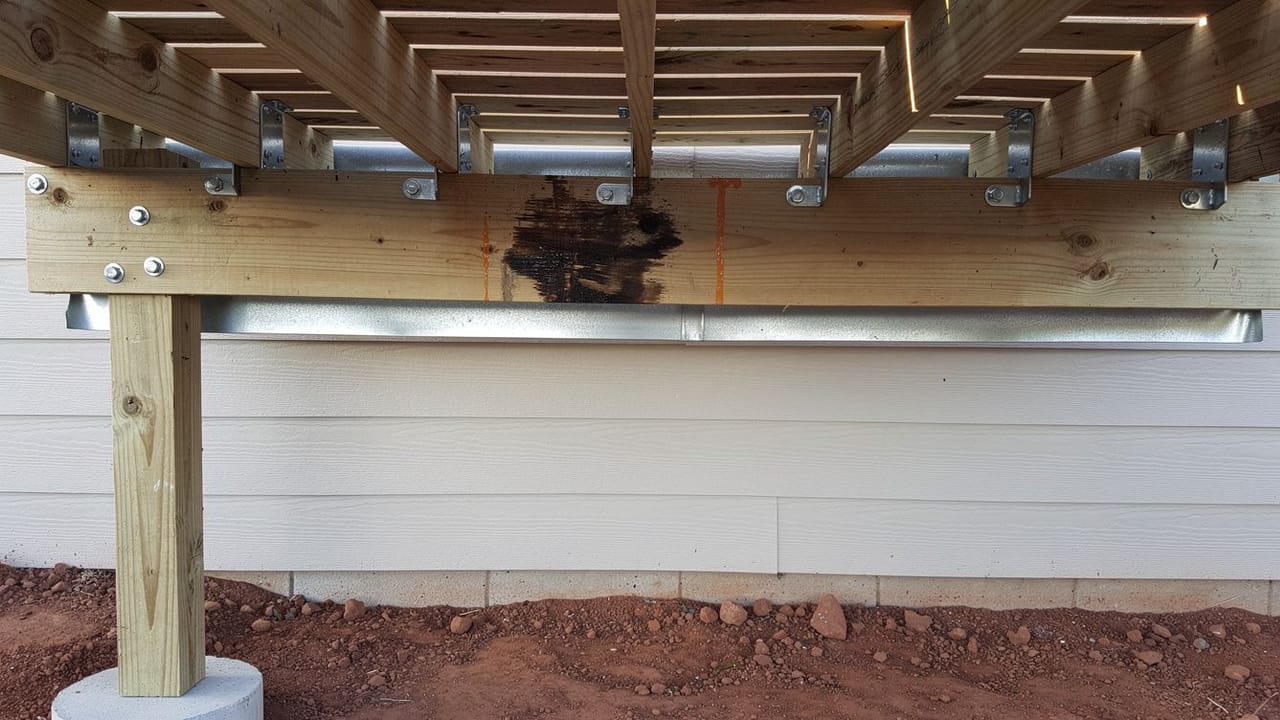
The same guide requires approved corrosion-resistant flashing at any ledger fastened to a wood-framed wall, so water running down the siding goes over the ledger instead of behind it. Water that gets behind an unflashed ledger can rot it, and the band joist with it, out of sight from the yard. Where we find soft framing there, the fix is structural: Metro Codes’ page on adding a deck says any replacement of deck footings or framing requires a permit, which is how we handle it on deck repair jobs.
What to check yourself
Push hard against the rail and against a post. Movement at the house end is the one we take most seriously. Then go under the deck and look along the ledger for dark staining, wood that gives under a screwdriver, and rust streaks running down from the fasteners.
Look at each post where it meets the ground and check that it stands on a footing, not on bare soil or a loose paver. DCA 6 wants footings on undisturbed soil at least 12 inches below grade or below the frost line, whichever is deeper, and it tells builders to ask the local building department where that frost line is. It also requires joist hangers and their fasteners to be corrosion resistant, and notes that where the hanger maker allows it, screws in place of nails make a joist less likely to pull away from the ledger.
- Ledger fastened with lag screws or bolts, not nails, with flashing above
- Posts on footings at least 12 inches deep or below the frost line, whichever is deeper
- Joist hangers with corrosion-resistant fasteners of the type the hanger maker specifies
- Guard posts attached with hold-down anchors rated for the load, not just screwed into a joist
- Stair stringers at least 2x12, with a post under any that span too far
How should a deck guard post be fastened?
Under DCA 6, any deck more than 30 inches above grade needs a guard, and a guard post is fastened to the outside or rim joist with hold-down anchors rated for at least 1,800 pounds of tension on a 36-inch guard. A post held only by a couple of screws into a joist is not that, and a rail that moves when you lean on it is worth a look underneath. The guide was written to the 2015 code, and Metro’s adopted codes list shows Nashville now enforces the 2024 International Residential Code with local amendments, so we confirm the details against the current edition before we build or rebuild a railing or stair.
Stairs are the other place we look closely. DCA 6 calls for stringers no smaller than 2x12, limits how far they can span, and allows a 4x4 post to shorten a span that runs too long. Any stair with four or more risers needs a handrail on at least one side, and the heights are set out in our post on deck railing height and code.
Which deck framing wears out first here?
On low decks with little air moving underneath, we look hardest at the framing nearest the ground, since that is the wood that stays wet longest after a rain. DCA 6 requires any lumber in contact with the ground to be preservative-treated wood approved for ground contact, and a post or beam that sits in the dirt without it is one we expect to replace.
Carpenter bees are the other thing we check for. University of Kentucky entomologists note that they prefer unpainted, weathered wood, especially softer species like cedar, cypress and pine, list decks among their usual nesting sites, and find painted or pressure-treated wood much less susceptible. Their entrance holes are perfectly round, about as wide as a little finger, often with coarse sawdust underneath, so bare cedar rails and joist ends are where we look. If any of this turns up on your deck, ask us for a free written estimate.
Sources
- American Wood Council, DCA 6 Prescriptive Residential Wood Deck Construction Guide (2015 IRC edition) — Band joist must support the deck; ledger lag screws or bolts staggered, only listed fasteners; no veneer attachment; ledger flashing; footings 12 inches or below frost line; corrosion-resistant hangers, screws reduce pull-away; guards over 30 inches; guard hold-downs 1,800 lb; stringers 2x12 and spans; handrail at four or more risers; ground-contact lumber; building official verifies ledger fasteners
- Metro Nashville Codes, Add a Deck or Patio to a Residence — New or replacement deck, footing or framing replacement, and board replacement over 100 sq ft need a permit; demolition alone does not; applicant schedules inspections
- Metro Nashville Codes, Adopted Codes List — 2024 International Residential Code adopted with local amendments
- University of Kentucky Entomology, ENTFACT-611 Carpenter Bees — Prefer unpainted weathered softwoods; decks among nest sites; painted or pressure-treated wood less susceptible; round entrance hole and sawdust
FAQ
The Part of a Deck That Actually Fails — questions
How often should a deck be inspected?
We suggest walking around and under it every spring, and having a proper look taken at any deck whose construction you do not know, such as one that came with the house. The ledger, the posts where they meet the ground and the guard post attachments are the places to start.
How long does a deck last in Middle Tennessee?
There is no single number we would stand behind. It varies with moisture and airflow, and framing low to damp ground with little air under it is the part we see wear first. Composite boards do not change what is underneath: the joists, beams and posts are still lumber, and the frame is what we judge a deck’s remaining life by.
Does a deck need a permit in Nashville?
Yes for a new deck or a replacement deck. Metro Codes says both require a permit, as does replacing any of a deck’s footings or framing, or replacing more than 100 square feet of deck boards. Tearing a deck down without replacing it does not. The applicant schedules the inspections with Metro, and the American Wood Council’s deck guide leaves verifying the ledger’s lag screws or bolts to the building official.
What should I look for when inspecting a deck?
Start at the ledger: lag screws or bolts instead of nails, flashing above it, and no dark staining, soft wood or rust streaks along it. Then check that each post stands on a footing, the joist hangers have corrosion-resistant fasteners, the rail stays put when pushed, and bare cedar shows no round carpenter bee holes.