
· by Michael Blair, Nashville's Deck
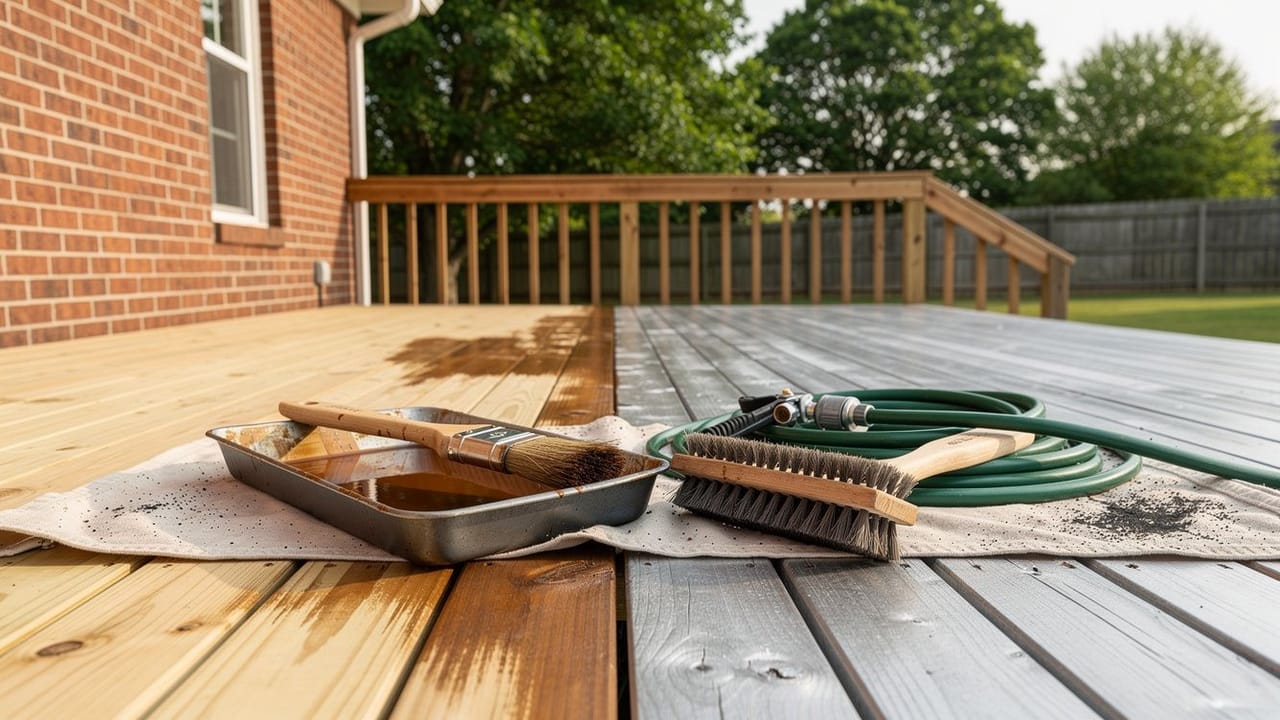
Poor preparation is one of the leading reasons a deck finish gives up early. The USDA Forest Products Laboratory’s Wood Handbook names four common causes of premature failure in paints and solid-color stains: water, wood that weathered before it was finished, inadequate surface preparation and a film that was too thin. Water is the one our climate supplies. NOAA’s relative humidity records put Nashville’s annual average at 84 percent in the morning and 56 percent in the afternoon, so we treat drying as a step of its own. When we refinish a deck as part of deck repair, most of the hours go into the work before the stain.
Why does a deck need cleaning before stain?
Bare wood left outside goes silvery gray because weathering strips the colored components from its surface, and the Wood Handbook says paint and solid-color stain will not bond to weathered areas. Mildew is the other thing we take off. A drop of household bleach on a dark spot tells us which it is: mildew usually bleaches out in a minute or two, and what stays dark is dirt, extractive bleed or iron stain. The handbook calls mildew an appearance problem, yet it can grow through a coating or under a clear finish, so a stain applied over it does nothing to stop it. Old finish matters as well. Oil-based semitransparent stain should not go over solid-color stain or paint, which means a deck that was painted once cannot simply switch to a penetrating stain.
Many deck cleaners rely on sodium percarbonate, an oxygen bleach that removes mildew and has been reported to be gentler on wood than chlorine bleach. A brightener is a separate product. Some contain oxalic acid, which takes out extractive bleed and iron stains but does nothing for mildew, and the handbook is blunt that cleaning adds no color: a brightened deck just looks as if it has more. The leaf marks that show up every fall are this kind of stain, and our post on fall leaves and tannin stains covers them. Where a peeling film has to be stripped with an alkaline stripper, the handbook’s advice is to neutralize the surface with a mild acid afterward, because alkali left in the wood can degrade the wood and the coating that follows.
Can you pressure wash a deck before staining?
We keep the pressure low, which is the handbook’s own advice for anyone using a power washer on wood. Too much pressure erodes the softer earlywood faster than the denser latewood beside it and leaves ridges of latewood standing, a surface the handbook describes as difficult to repaint. On a deck we use a wide tip and keep the wand at a steady distance so no stretch of boards gets more than the rest.
A deck that has already been washed too hard usually needs sanding before it will take stain evenly, and that is far more work than washing it gently in the first place.
- Clean with a deck cleaner made for the job, not just water
- Use a brightener where there are tannin or iron stains
- Low pressure, a wide tip and a steady distance
- Let it dry fully, longer in shade and in humid weather
- Sprinkle water on the boards: if it beads, it is not ready
Drying time is longer than you think
The handbook says to refinish a cleaned surface as soon as it has dried, and it does not put a number of days on that. Our weather is why the wait runs longer than people expect. The National Weather Service’s Nashville climate page gives a normal of 50.51 inches of precipitation a year, with 79 days bringing a tenth of an inch or more, and the morning humidity average in NOAA’s table climbs to 89 percent in August and September. In our experience a deck in shade, or one that was washed heavily, holds water noticeably longer than one in full sun. We go by the drying requirement on the label of the stain we are using.
Before we open the stain we sprinkle a little water on the boards. If it beads, something is still keeping liquid out, most often an old water repellent still on the surface; the handbook notes that clear finishes lose their water repellency as they weather, so beading means one has not finished wearing off. If the water darkens the wood and soaks in, the surface is ready to take a penetrating stain.
Which deck finish holds up best?
Semitransparent stains are porous and form no surface film, so they will not blister or peel even with too much water around, and the oil-based ones wear away by slow erosion of the pigment. Waterborne latex semitransparent stains are a different product: they form a thin film, and the handbook says they tend to crack and flake. Solid-color stains are opaque and hide the grain. Unless one is formulated specifically for decks, the Forest Products Laboratory says solid-color stain should not be used on a deck at all, because it lacks abrasion resistance and tends to fail by peeling.
So on most wood decks we use an oil-based semitransparent stain. The trade-off is that it needs reapplying more often than paint would, but it seldom cracks or peels, so the next coat is a clean and a recoat with no stripping. We brush it on, since the handbook names the brush as the best method and warns that rollers and sprayers can put too much stain on a horizontal surface, and anything still shiny an hour later gets wiped off before it can dry into a thin film that cracks and peels within a year or two. If you are weighing whether to keep refinishing wood at all, our comparison of composite and wood decking goes through that choice, and if you would like us to look at your deck, ask us for a free written estimate.
Sources
- USDA Forest Service, Forest Products Laboratory, Wood Handbook: Wood as an Engineering Material, FPL-GTR-190 (2010) — Chapter 16: causes of premature finish failure; weathering and the gray surface; film finishes do not bond to weathered wood; mildew bleach test and growth through a coating; no oil semitransparent stain over solid stain or paint; sodium percarbonate cleaners and oxalic acid brighteners; cleaning adds no color; neutralize after alkali strippers; low pressure power washing and earlywood erosion; refinish once dried; clear finishes lose water repellency; semitransparent stains do not peel, latex ones crack and flake; solid-color stains not for decks unless formulated for them; deck finishes need more frequent application; brush application; wipe off shiny excess after an hour; removing film finishes is difficult. Chapter 15: water added in treatment, kiln-dried after treatment; treatment has little effect on finishing once dry
- NOAA NCEI, Comparative Climatic Data: Average Relative Humidity, data through 2023 — Nashville annual average 84 percent morning and 56 percent afternoon; 89 percent morning in August and September
- National Weather Service Nashville, Nashville Climate — Normal annual precipitation 50.51 inches; 79 days a year with 0.10 inch or more
FAQ
Cleaning and Sealing a Deck Properly — questions
How long should a deck dry before staining?
Until the boards are dry through, and no single number of days fits every deck. Nashville is humid, with an average morning relative humidity of 84 percent in NOAA’s records, so a shaded or heavily washed deck takes longer. Follow the drying requirement on the stain label and make sure a few drops of water soak in rather than bead.
Should I use a solid stain or semi-transparent?
Semi-transparent on most decking. An oil-based semitransparent stain soaks in and wears away gradually, so recoating means cleaning and applying again. The Forest Products Laboratory advises against solid-color stain on decks unless the product is made for them, because it lacks abrasion resistance and tends to peel, and removing a film finish from wood is slow, often difficult work.
Can I stain a new pressure-treated deck right away?
Usually not. Water is added to the wood in the treatment process, so standard treated lumber keeps drying and shrinking after it is installed, and the treatment has little effect on finishing once the wood has dried. Wait until water soaks in rather than beads and check the stain label for its own requirement. Lumber sold as kiln-dried after treatment has had that water dried out before it is sold, so it can be ready sooner.
Why does deck stain peel?
Usually because it formed a film the deck could not hold. Solid-color stain not made for decks lacks abrasion resistance and tends to peel, latex semitransparent stain forms a thin film that cracks and flakes, and oil stain left shiny on the surface dries into a film that cracks and peels within a year or two.